Q.01Do you install solar film in homes and condos?
Yes. We install solar film in homes, condos and businesses across Toronto and the GTA. We review your glazing, room priorities and any condo approval requirements before selecting a film. Book a free on-site assessment for a written quote.
Q.02Is solar window film a replacement for blinds?
Film provides a fixed level of solar control while leaving the glass uncovered. Blinds can be adjusted for changing sun, presentations or night-time privacy. Some rooms benefit from both. Choose film for the everyday heat and daylight requirement, then assess whether an adjustable covering is still needed.
Q.03Can solar film be applied to double-pane or Low-E windows?
There is no blanket approval. Glass construction, coating location, pane size, condition and exposure affect film selection. Share the window specifications or available glass markings so the proposed product can be checked against XPEL’s film-to-glass requirements.
Q.04Will solar film reduce heating costs in an Ontario winter?
Do not assume that it will. Reducing solar gain can also reduce useful winter warmth, increasing heating demand. Annual energy results need a building-specific assessment that includes cooling, heating, orientation and operating hours.
Q.05Can solar film fix condensation or failed window seals?
Solar film is selected for solar heat, glare and UV control. It does not repair failed seals or address every cause of condensation. Have moisture or glazing defects assessed before choosing film.
Q.06Can solar and privacy film be installed on the same glass?
Describe both requirements during the assessment. We check whether a suitable product or approved installation approach can address them. Do not assume separate films can be layered together or that solar film provides dependable night-time privacy.
Q.07What is the difference between Clear View Plus 70 and Plus 40?
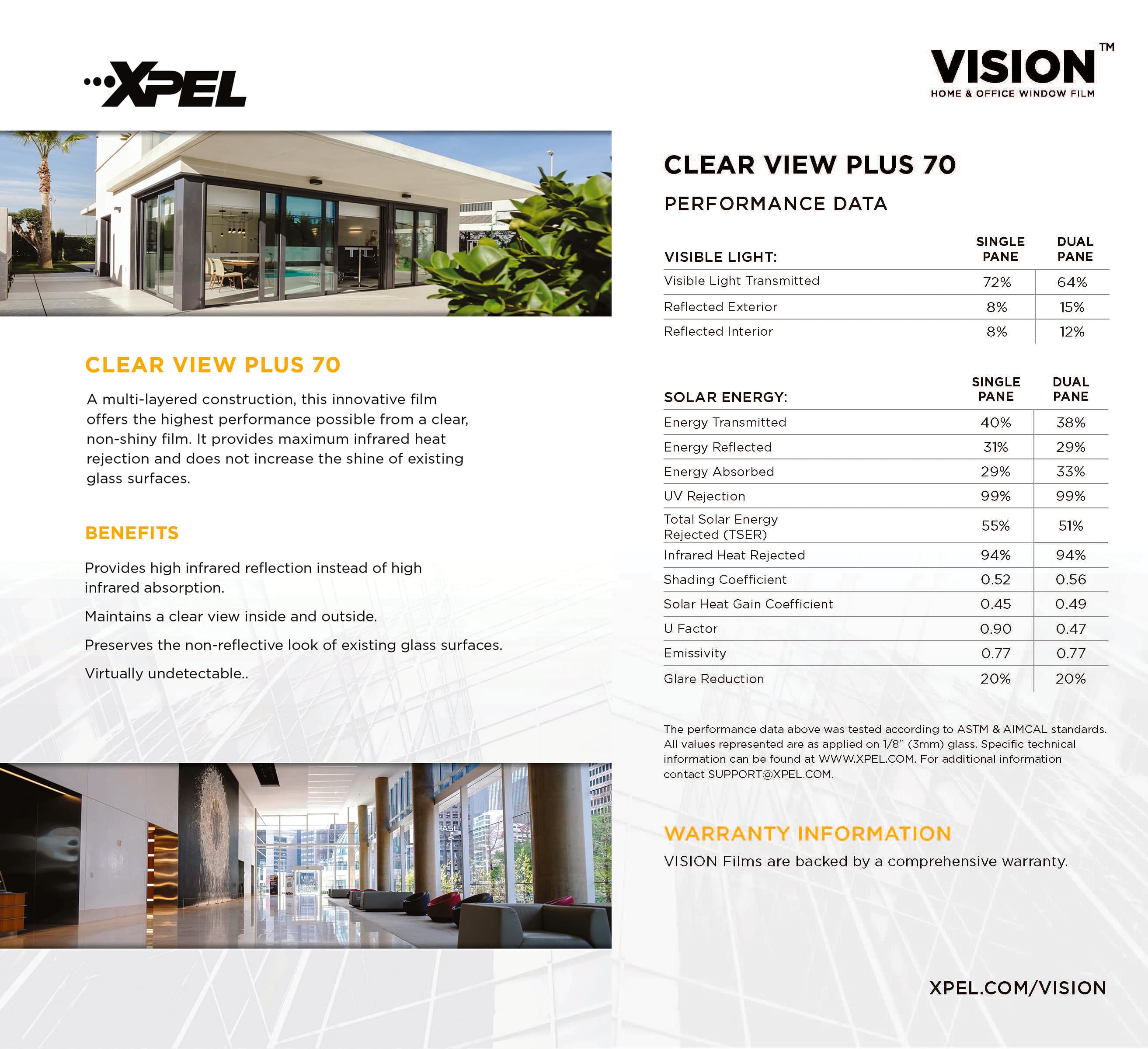
In XPEL’s nominal 3 mm glass data, Plus 70 transmits 72% of visible light with 55% TSER and 20% glare reduction. Plus 40 transmits 40%, with 62% TSER and 53% glare reduction. Compare daylight and glare needs before selecting.
Q.08Will solar film make the windows darker?
The effect depends on the film’s visible light transmission. Lighter Clear View products retain more daylight; darker shades reduce more visible light. We review samples before you approve a finish.
Q.09How much glare does clear-view film reduce?
XPEL lists 20% glare reduction for Clear View Plus 70, compared with 53% for Clear View Plus 40, on 3 mm glass. A lighter film may not provide enough glare control for every workstation.
Q.10Does total solar energy rejection equal energy-bill savings?
No. TSER describes solar energy rejected by the film-and-glass combination. Building energy use also depends on glazing area, orientation, insulation, HVAC operation and heating needs.
Q.11Does solar film prevent fading?
Solar film reduces UV exposure, one contributor to fading. Visible light, heat and material sensitivity also matter. Film cannot prevent all fading.
Q.12Can film be installed on existing glazing?
Suitability depends on glass type, coatings, condition, size and exposure. We check the proposed film against XPEL’s film-to-glass requirements before specifying it.
Q.13Does reflective film provide privacy at night?
Reflective screening depends on relative light levels. When the interior is brighter, people outside may see in. Frosting obscures direct views but may still show silhouettes. Review a sample with the room lights on and consider a suitable separate covering if the required privacy is not met.
Q.14How soon can installation start, and how long will it take?
Timing depends on film availability, glazing area, access and building restrictions. Include your required completion date in the enquiry. We confirm the start date, estimated duration and any installation phases before booking.