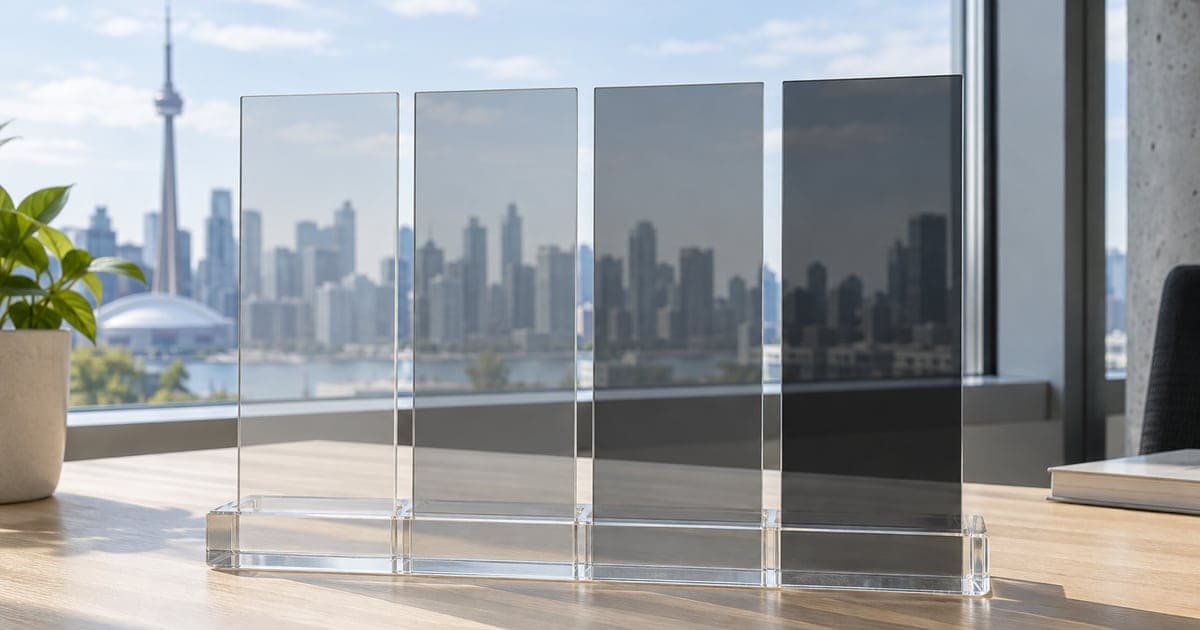
A useful commercial window film VLT comparison starts with the room's requirements. Choosing the darkest film because it rejects more solar energy can sacrifice daylight unnecessarily. Choosing the lightest film without checking glare can leave the original complaint unresolved.
Our recommendation is to shortlist the lightest candidate that meets the room's glare requirements. Then review its appearance on the actual glass before approval. The specification table helps narrow the shortlist. It cannot make the final decision for a workplace, showroom or customer-facing space.
Commercial window film VLT comparison on the same glass
VLT means visible light transmission. It describes the visible light passing through the tested film-and-glass combination. It does not measure how sharply a person can see through it.
XPEL's table lists these nominal values with film applied to 3 mm glass. They are guidance values, not measurements of your building's windows. XPEL VISION specification sheet R0326V3, page 1.
| Film | Listed VLT | Total solar energy rejected, TSER | Listed glare reduction | Exterior visible reflectivity |
|---|---|---|---|---|
| Clear View Plus 70 | 72% | 55% | 20% | 8% |
| Clear View Plus 55 | 58% | 57% | 34% | 7% |
| Clear View Plus 40 | 40% | 62% | 53% | 6% |
| Clear View Plus 20 | 21% | 67% | 77% | 5% |
Every table value comes from the same manufacturer sheet and glass basis. XPEL R0326V3.
The product name is an identifier, not an exact transmission reading. Plus 70 has a listed VLT of 72%; Plus 55 is 58%. Plus 20 is 21%. Specify both the full product name and the measured column when comparing proposals. XPEL R0326V3.
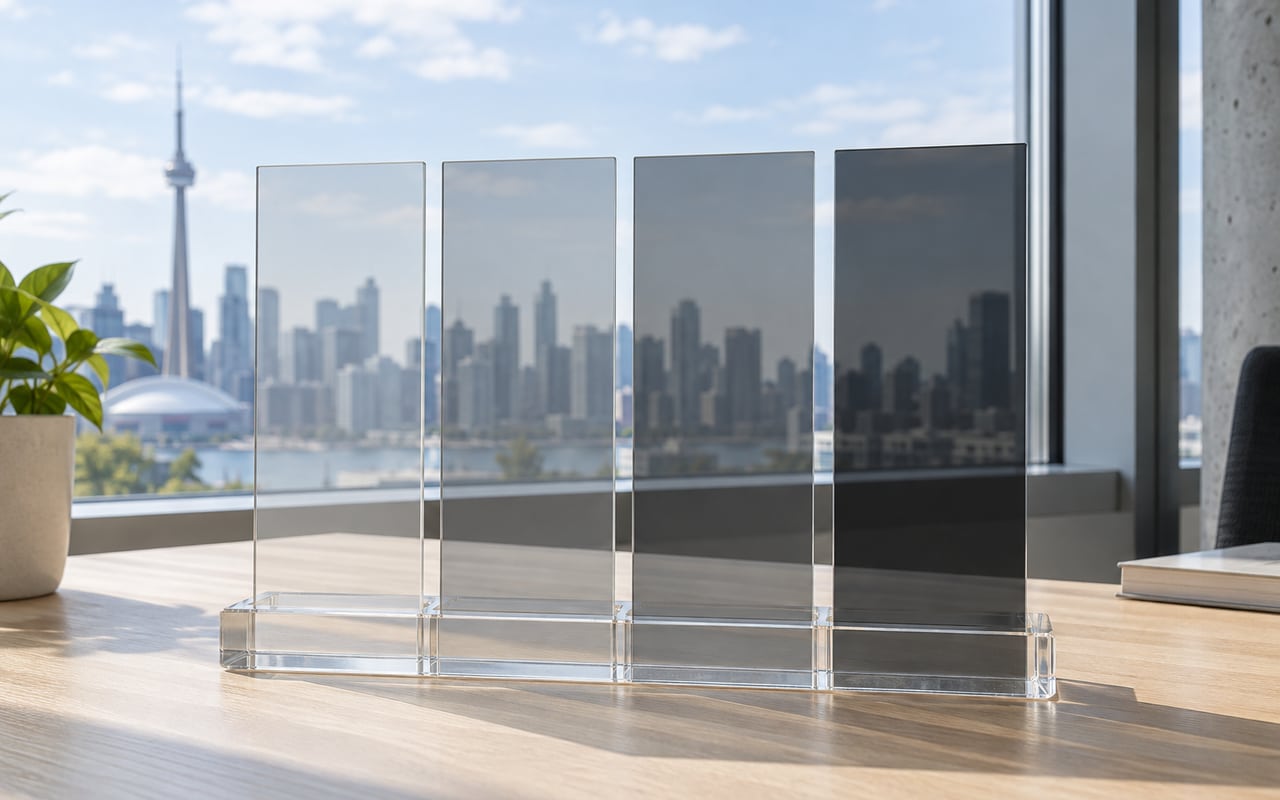
Illustrative image.
VLT is different from optical clarity
People often use “clarity percentage” when they mean how light or dark a film looks. That shorthand can create a poor specification.
A transmission value answers how much visible light passes through the tested assembly. It does not provide a haze score, a distortion rating or a colour-neutrality rating. The cited table contains no optical-clarity ranking between these products. XPEL R0326V3.
Keep those requirements separate. Ask whether staff can still see comfortably through the windows. Review colour appearance beside an untreated window. For retail, inspect products and displays from the customer approach. For offices, review the view from seated work positions.
A photograph or monitor preview should not become the appearance acceptance standard. Use a physical sample on representative glass, with the people responsible for approving the result.
Plus 70 and Plus 55: make the daylight trade explicit
Plus 70 is the first candidate to examine when retaining light is a high priority. That recommendation follows its position in this comparison, not an assumption that lighter is always better.
Moving from Plus 70 to Plus 55 lowers listed VLT by 14 percentage points. TSER rises by 2 points, and glare reduction rises by 14 points. Those differences are calculated from XPEL's nominal values. XPEL R0326V3.
That is a useful procurement distinction. If heat is the only stated problem, ask why the proposed reduction in light is necessary. If brightness on screens is also a problem, the additional glare reduction may be relevant.
Do not call the difference “14% darker.” A percentage-point change in transmission is not a measured change in perceived room brightness. Write the actual VLT figures into the comparison instead.
Request a commercial solar-film review with photographs and a description of the affected rooms. Clear Guard qualifies requests by phone before scheduling a site visit.
Plus 40 and Plus 20: require a stronger glare case
Plus 40 is worth reviewing when the lighter samples do not sufficiently address the room's brightness problem. Plus 20 deserves closer scrutiny where reducing glare takes priority over retaining daylight.
Moving from Plus 40 to Plus 20 lowers listed VLT by 19 percentage points. TSER increases by 5 points, while listed glare reduction increases by 24 points. These are arithmetic comparisons of the manufacturer's nominal figures. XPEL R0326V3.
The darker option therefore needs a room-specific justification. Review it during the complaint period and when direct sun is absent. Ask staff whether the reduction in light is acceptable throughout their working day.
Avoid specifying the darkest candidate across an entire property because one room needs it. Group windows by exposure, use and appearance requirements. Check whether different selections would create an unacceptable exterior mismatch before approving separate zones.
Apply the comparison to the building's use
For a restaurant, review the affected tables during the actual dining period and check the appearance after dark. A film that makes afternoon seating more comfortable still needs an acceptable evening appearance. For a showroom, inspect the display from outside as well as from the staff's position inside.
For industrial glazing, preserve sightlines that staff need for supervision and operating procedures. For multifamily common areas, review amenity rooms, reception and circulation spaces as distinct zones, with the building's approving representative. The property type changes the acceptance criteria; it does not change what the manufacturer's VLT column measures.
TSER and reflectivity need their own decisions
TSER is a solar-energy performance metric. It is not a prediction of the percentage reduction in your electricity bill. Building energy savings require an assessment of the building and operating conditions.
Likewise, reject proposals that convert these figures into a promised room-temperature drop. The comparison supports product selection; it does not describe the whole building's thermal behaviour.
Exterior reflectivity also deserves attention. In this specific Plus comparison, the darker products have lower listed exterior reflectivity. Darkness and a reflective exterior appearance should not be treated as the same property. XPEL R0326V3.
Do not turn that observation into a privacy guarantee. If the requirement is obscuring views into meeting rooms or other occupied spaces, describe it separately. Review commercial privacy film against that requirement.
Put sample approval into the purchase scope
The written scope should identify the film, the windows receiving it and the accepted sample location. Include the existing glass information available to the building team.
Have compatibility reviewed before approving the selection. XPEL maintains a separate film-to-glass chart; the performance table alone is not a compatibility approval. XPEL product specifications.
Record who approves exterior appearance and who signs off on occupied-room conditions. Note access restrictions, furniture clearance and the acceptable installation schedule. If the proposal changes products after approval, require another review of the relevant specifications and appearance.
This makes a VLT comparison useful beyond the buying conversation. It gives the installer and property team a shared record of what was selected and why.
Request a commercial solar-film quote. Share the property location, affected windows and your priorities for daylight and glare. Clear Guard serves Southern Ontario and qualifies requests by phone before scheduling a site visit.
For Low-E or double-pane glazing, gather the glass information and confirm compatibility separately.
Frequently asked questions
Does Plus 70 mean exactly 70% visible light transmission?
No. XPEL lists 72% VLT for Clear View Plus 70 on the stated test glass. The product name and transmission column are different fields. XPEL R0326V3.
Does lower VLT mean worse optical clarity?
VLT measures transmission, not image sharpness. Do not infer a clarity ranking from that number. Review the sample for both the amount of light and the quality of the view.
Should every window receive the same film?
That depends on exposure, room use, compatibility and appearance requirements. A consistent exterior may matter to the property owner. Review those constraints before specifying different films in separate areas.
Related reading
Commercial solar window film specifications · Commercial window film services · Privacy film.