Commercial window film quotes are easier to compare when every installer is responding to the same scope. A proposal labelled “window tint throughout” leaves too much undecided.
Before requesting proposals, identify the rooms, glass and outcomes involved. Then ask each installer to return a matching schedule with product selections, assumptions and exclusions.
The procurement goal is a decision you can explain to building management and occupants. A total alone cannot establish whether competing proposals include the same work.
Build a room-by-room commercial window film quote schedule
Use a floor plan or annotated photographs to give each glass location a reference. Separate exterior windows, internal partitions and glass doors.
For each location, record its use and the problem being addressed. Include the time of day when occupants notice the problem.
An illustrative schedule might distinguish afternoon screen glare at perimeter desks, visual screening at a consultation room and an independently assessed security requirement at an entrance. These are different requests, even within the same building.
For restaurants, record service periods and access to dining areas. For industrial premises, distinguish staff offices from production areas. For multifamily projects, identify common areas separately from suites and name the approving building representative.
Give every installer the same schedule. Ask them to mark proposed changes explicitly, rather than quietly treating fewer panes or substituting another finish.
| Procurement item | What the proposal should identify | Clarification to request |
|---|---|---|
| Locations and quantities | Room references, panes and measured treatment area | Which panes are excluded or awaiting measurement? |
| Intended result | The priority for each location | Is this addressing solar control, visual privacy or security? |
| Product | Manufacturer, family, exact product and finish | Is any substitution allowed without approval? |
| Existing glazing | Known glass details and unresolved assumptions | Who will verify compatibility before installation? |
| Coverage | Full-pane treatment or dimensioned partial coverage | Are doors and adjacent panes included? |
| Preparation | Existing film removal and glass preparation | What conditions could change the scope? |
| Access and scheduling | Working hours, room availability and access arrangements | Who moves furniture and coordinates building access? |
| Approval and handover | Sample sign-off, inspection and care instructions | Who accepts the work and records any corrections? |
Keep unresolved items visible. “To be confirmed” is useful when it names the responsible person and the decision required before work proceeds.
Compare specifications beyond TSER
Total solar energy rejection, or TSER, belongs in a solar-film comparison. It is not a complete purchasing specification.
XPEL's architectural specification sheet lists heat rejection alongside visible light transmission, interior and exterior reflectivity, and glare reduction. Its footnote identifies the reference glass and describes the figures as nominal guidance. Source: XPEL VISION specification sheet.
Ask the installer to identify which figures support your room's priority. Then ask whether competing figures use comparable glass and reporting conditions.
A higher TSER entry does not answer whether staff will accept the appearance or whether the proposed finish satisfies a privacy brief. Those need separate review.
Use the solar window film product information to frame the discussion. Request the current data sheet for the exact proposed product, including any alternative offered.
Require a reason for using the same film everywhere
A common finish can be a legitimate building requirement. It should still be an explicit decision supported by the room schedule.
Ask the installer to explain where a repeated product suits the brief and where another selection deserves consideration. Keep exterior appearance requirements alongside occupant priorities.
Do not assume identical-looking windows have identical glazing. Request confirmation of the existing glass and film-to-glass suitability for the proposed locations. XPEL maintains architectural film-to-glass charts within its technical resources.
If records are incomplete, identify the verification step before approving the final specification. Photographs support an initial discussion; they should not silently become confirmation of unknown glass construction.
For help organizing the scope, send your project details for a commercial quote. Clear Guard reviews the requirements by phone before arranging a site assessment.
Separate solar, privacy and security requirements
Write each requirement on its own line, even when several apply to the same area.
For solar work, describe the heat or glare concern and the views and appearance you want to retain. For privacy work, identify what must be screened and where observers stand.
The privacy film product page covers decorative finishes. Ask for the selected finish and coverage layout to appear in the proposal together.
If security is also required, request a separate assessment and specification. A solar rating or decorative finish does not establish the security scope.
Do not accept “all-in-one” as the specification. Ask which proposed product addresses each requirement and what remains outside the installation scope.
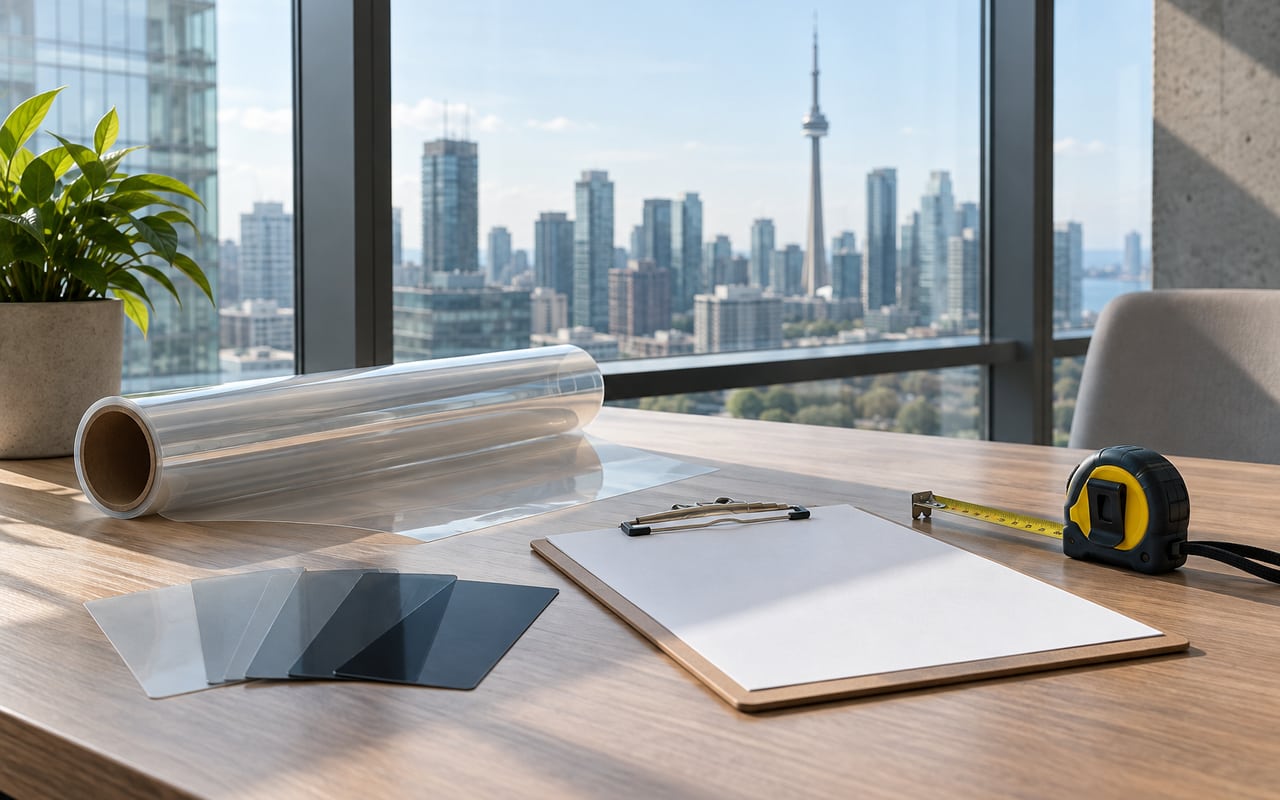
Illustrative image.
Approve a sample with recorded acceptance criteria
A sample review should produce a decision that the installation team can follow.
Agree where the sample will be reviewed, which product it represents and who has approval authority. Include the people responsible for the room's use and building appearance.
For exterior glazing, inspect the appearance from inside and outside under relevant operating conditions. For partitions, use the intended furniture positions and viewing locations.
Record the approved product, location and coverage on a photograph or drawing. Note any differences approved between rooms.
Keep appearance approval separate from compatibility confirmation. Also ask the installer to document the appropriate final inspection timing and conditions for the selected product.
A sample cannot establish future building energy savings or prove security performance. Request relevant supporting documentation separately if either claim appears in a proposal.
Resolve permissions and access before authorizing work
Identify who can authorize changes to the glass and exterior appearance. In leased premises, confirm the building's approval process with management before committing to an installation date.
Assign responsibility for access arrangements, furniture relocation, equipment protection and occupant notifications. Ask whether the proposed work requires additional access equipment or restricted areas.
If work must be phased, list the rooms in order and confirm when each becomes available. Record how scope changes will be approved.
At handover, retain the installed product schedule, approved layouts, care instructions and outstanding correction list. These records make later additions or replacements easier to specify.
Use the commercial installation preparation checklist to assign access, furnishings and cleaning-handover responsibilities before the work period.
Request a commercial window film quote
Clear Guard supplies and installs commercial window film across Southern Ontario. Send your room schedule, photographs and project requirements; we review the scope by phone before arranging a site assessment.
Before accepting a film specification, review the available Low-E and double-pane glazing records.
Frequently asked questions
Can installers quote from photographs and approximate dimensions? These help establish an initial scope. Ask which measurements, glass details and access conditions still need confirmation before the proposal is finalized.
Should every room receive the same window film? Only when the selection fits the documented requirements and glazing. Ask for the rationale and record any room-specific exceptions before approval.
How should I compare proposals with different products? Return to the shared location schedule. Compare the intended result, exact product, glazing assumptions, preparation and access scope, then resolve the differences in writing.
Related reading
Explore commercial window film services for the available service categories.
Compare film specifications · Evaluate building energy savings.