Security window film is easy to describe badly. It does not make glass unbreakable, and the thickest option is not automatically right for every window. Its practical job is to hold fractured glass together so the pane takes more work to clear.
This guide covers what film changes, where it helps, how Clear Guard’s interior-and-exterior system works, and when bars, laminated glass, or replacement may be a better fit.
The aim is not to convince you to cover every pane. It is to help you identify which glass deserves attention and which glass may be a low priority.
What security window film is — and what it actually does
Security window film is an adhesive-backed polyester layer applied to existing glass. The glass can still crack. The film is designed to retain the fragments and make the damaged pane harder to clear. XPEL describes its safety and security film in the same restrained terms: it holds glass fragments together and adds a layer of resistance.
That distinction matters. Film changes what happens after the glass fractures; it does not make the window invulnerable. Performance also depends on the glass, frame, film selection, and installation details. Those variables are why a property assessment comes before a recommendation.
Film is applied to one of two surfaces. Interior security film bonds to the inside face of the glass and is the most common choice for homes. Exterior security film bonds to the outside face and is used in specific situations the technician will identify on site. The two are not interchangeable, and matching the film to the correct surface is part of why the assessment matters.
For the full frame-by-frame picture of what happens at the moment of impact, read How Security Window Film Works: A Visual Guide.
Does security window film actually stop break-ins?
No. Film adds resistance after the glass breaks; it cannot guarantee that someone will never get through. The useful comparison is untreated glass versus a filmed pane in a compatible frame—not “breakable” versus “break-in proof.”
If a pane stays together instead of falling away, clearing it requires additional work. That can buy time and create more noise, but the result varies by the complete glazing system. Clear Guard therefore avoids universal time or force claims.
For the full case, including how delay maps to real intruder behaviour, read Does Security Window Film Actually Stop Break-Ins?.
What film system does Clear Guard usually install?
Clear Guard’s primary residential specification combines 14 mil interior security film with 7 mil exterior security film on the same pane. Most clients receive both, subject to the glass, frame, and site assessment.
The interior and exterior products are designed for different surfaces. Together, they help retain fractured glass from both sides. They do not make the pane unbreakable or guarantee that entry is prevented.
Where privacy is also required, Clear Guard offers 12 mil frosted matte interior security film. It combines the glass-retention purpose of security film with an intentionally obscured finish.
An 8 mil interior security film remains available for selected applications, but it is not our standard residential specification. Read the security film system guide for the full breakdown.
Security film versus window bars
Window bars are a visible physical barrier; film is an invisible reinforcement of the glass you already have. Bars change the look of the home and can raise egress concerns in bedrooms; film is reversible, optically clear, and preserves the home's character — which is why heritage and high-value owners often choose film over bars when both would work.
Both approaches buy delay, but they do it in opposite ways. Bars stop a body from passing through the frame even after the glass is gone. Film keeps the glass itself from clearing in the first place. Bars are immediately obvious from the street; film is invisible once cured.
The biggest practical difference is egress. Fixed bars on a bedroom window can trap occupants in a fire, which is a real safety trade-off film does not carry. For most homeowners who want delay without changing the look of the house or compromising escape routes, film is the lower-friction choice.
There are situations where bars still make sense — a low-traffic utility window, a commercial back entry, or a basement window that is not a required escape route. The point is not that one is always right. It is that bars and film are not competing for the same job on every window, and the better question is which approach fits each specific pane and the way the household uses it.
For the full comparison, including the bedroom egress rule most homeowners miss, read Security Window Film vs. Window Bars.
Security film versus laminated glass
Laminated glass bonds an interlayer between two panes during manufacture; film is applied to glass you already own. They solve different problems — laminated glass is a replacement decision, film is a retrofit. For existing windows, film delivers comparable hold-together behaviour without removing the original glass or rebuilding the window.
Laminated glass is a strong choice when you are already replacing a window or specifying a new build, because the interlayer is engineered in from the start. But ripping out sound existing glass purely to gain that interlayer is a large, costly project for most homes.
Film reaches a similar outcome — a pane that stays bonded when struck — on the glass that is already in the frame. If your windows are otherwise fine and the goal is forced-entry delay, the retrofit usually makes more sense than the replacement.
For the side-by-side, see the comparison section on our security window film page.
Film versus full window replacement — cost and security compared
Full window replacement upgrades the whole window — frame, seal, and glazing — at the highest cost and disruption. Film reinforces the existing glass for a fraction of the effort and keeps the original windows in place. If the goal is forced-entry delay rather than energy efficiency or new aesthetics, film is usually the proportionate choice.
Homeowners often assume that newer windows are automatically more secure. They are not, by default. A brand-new window with ordinary glass still clears on impact the same way an older one does. Replacement solves energy loss, drafts, and appearance — it does not, on its own, solve forced-entry delay.
So the right question is which problem you are actually trying to solve. If the windows are failing or you want better insulation, replacement may be worth it. If the windows are sound and the concern is security, film addresses that directly without the larger project. On pricing, we keep it simple: we do not publish figures. A free on-site assessment ends with a written quote.
For the full comparison of film, laminated glass, and replacement, read Window Film vs. Window Replacement: Cost and Security.
Security film versus the alternatives at a glance
The four approaches above solve overlapping problems in different ways, so it helps to see them side by side. The matrix below compares security film, window bars, laminated glass, and full window replacement across the things that actually drive the decision. The marks are qualitative — yes, partial, or no — and the language is delay, not prevention. There are no cost figures or force ratings here on purpose; those depend on your specific glass and are settled in the written quote, not on a chart.
| What matters | Security film | Window bars | Laminated glass | Full window replacement |
|---|---|---|---|---|
| Reinforces the glass you already have | Yes | No | No | No |
| Optically clear / preserves appearance | Yes | No | Yes | Partial |
| Reversible later | Yes | Partial | No | No |
| Retrofit — no glass removed | Yes | Yes | No | No |
| Adds forced-entry delay | Yes | Yes | Yes | Partial |
| Relative disruption to install | Low | Low | High | High |
Read each row against your own situation rather than looking for an overall "winner." If your windows are sound and the goal is delay, film leads on most rows. If you are already replacing windows for energy or age reasons, laminated glass earns its place. Bars buy delay but change the look of the house and raise egress questions. Replacement is the biggest project and is rarely justified by security alone.
A Clear Guard technician can walk the property with you and point out the glass most homeowners overlook—the panes that are easy to reach, screened from the street, or close to a latch. Assessments are free and on-site, and they end with a written quote.
Which windows need film most — basement and grade-level glass
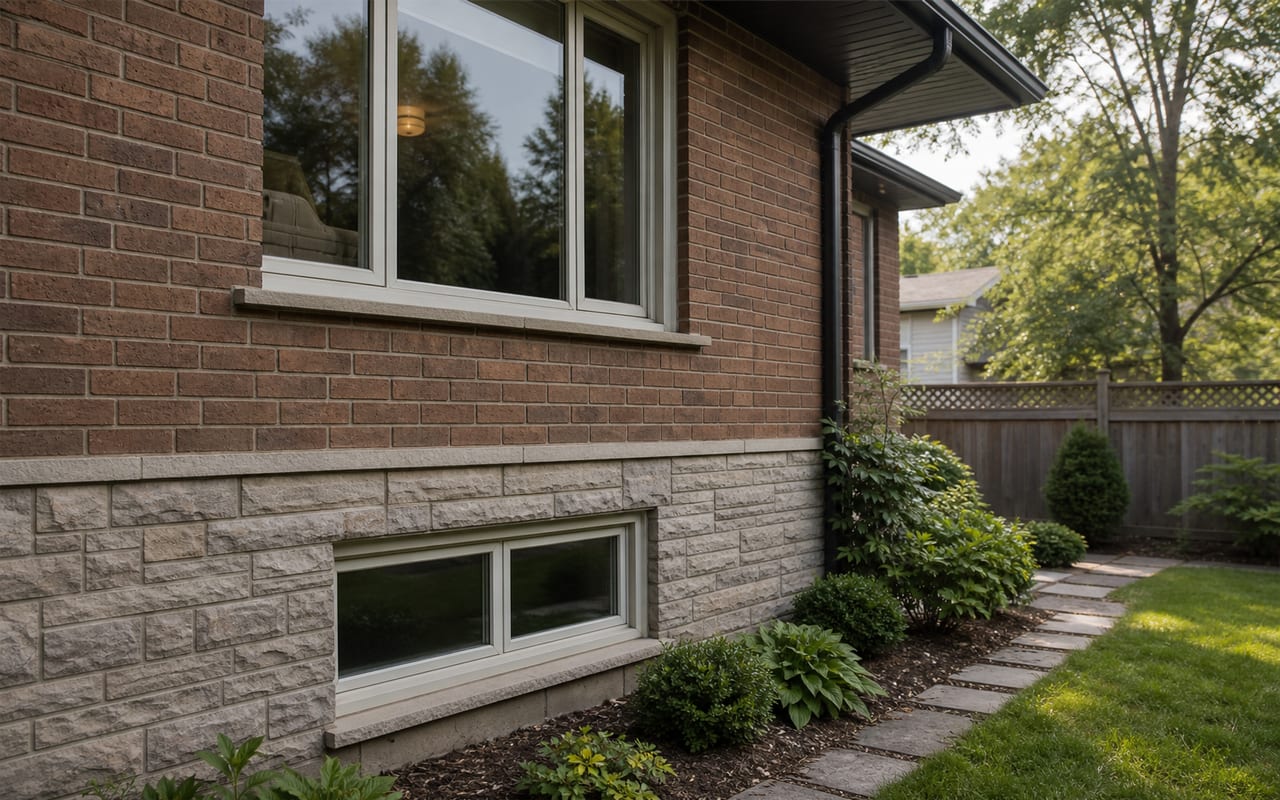
The most exposed glass is usually the least obvious. Basement and grade-level windows are often single-pane, close to the ground, screened from the street by hedges or window wells, and overlooked in security planning entirely. For many homes, these are the right place to start a film plan — not the big, visible front windows.
The instinct is to film the largest, most prominent windows first. But prominence is not the same as exposure. A large front window in full view of the street carries its own informal deterrent — people can see it. A small basement window tucked into a well, single-pane and out of sight, has none of that.
Grade-level glass combines several risk factors at once: it is within easy reach, it is often the weakest glass in the house, and it is the hardest for neighbours to watch. That combination is why it so often tops the priority list once someone actually walks the perimeter.
For why grade-level glass is so often the right answer, read Basement Windows and Grade-Level Glass.
How to assess your own glass before you book
Before investing in anything, identify what glass you actually have. A few simple, safe checks — pane count, frame age, and each window's location relative to the street and the ground — tell you whether film, replacement, or nothing at all is the right call for that window. This is the homeowner's pre-assessment, and it costs nothing.
You do not need tools or expertise to do a first pass. Walk the inside of the house and note which windows are single-pane versus double, how old the frames look, and how reachable each window is from the ground. Then walk the outside and note which windows are hidden from the street.
The goal is not to make the final decision yourself — it is to arrive at the assessment already understanding your own home. A window that is double-pane, sheltered, and high off the ground is a low priority. A single-pane window at grade, hidden behind a fence, is a high one.
A simple way to organize the walk-through is to score each window on three questions. Is it single-pane or double? Is it within easy reach from the ground? Can it be seen from the street or a neighbour's window? A window that scores poorly on all three is where a film plan tends to start. A window that scores well on all three may not need film at all — and an honest assessment will tell you that rather than filming every pane in the house.
For the step-by-step self-check, read The Glass Breaker Test.
What installation day looks like — and after
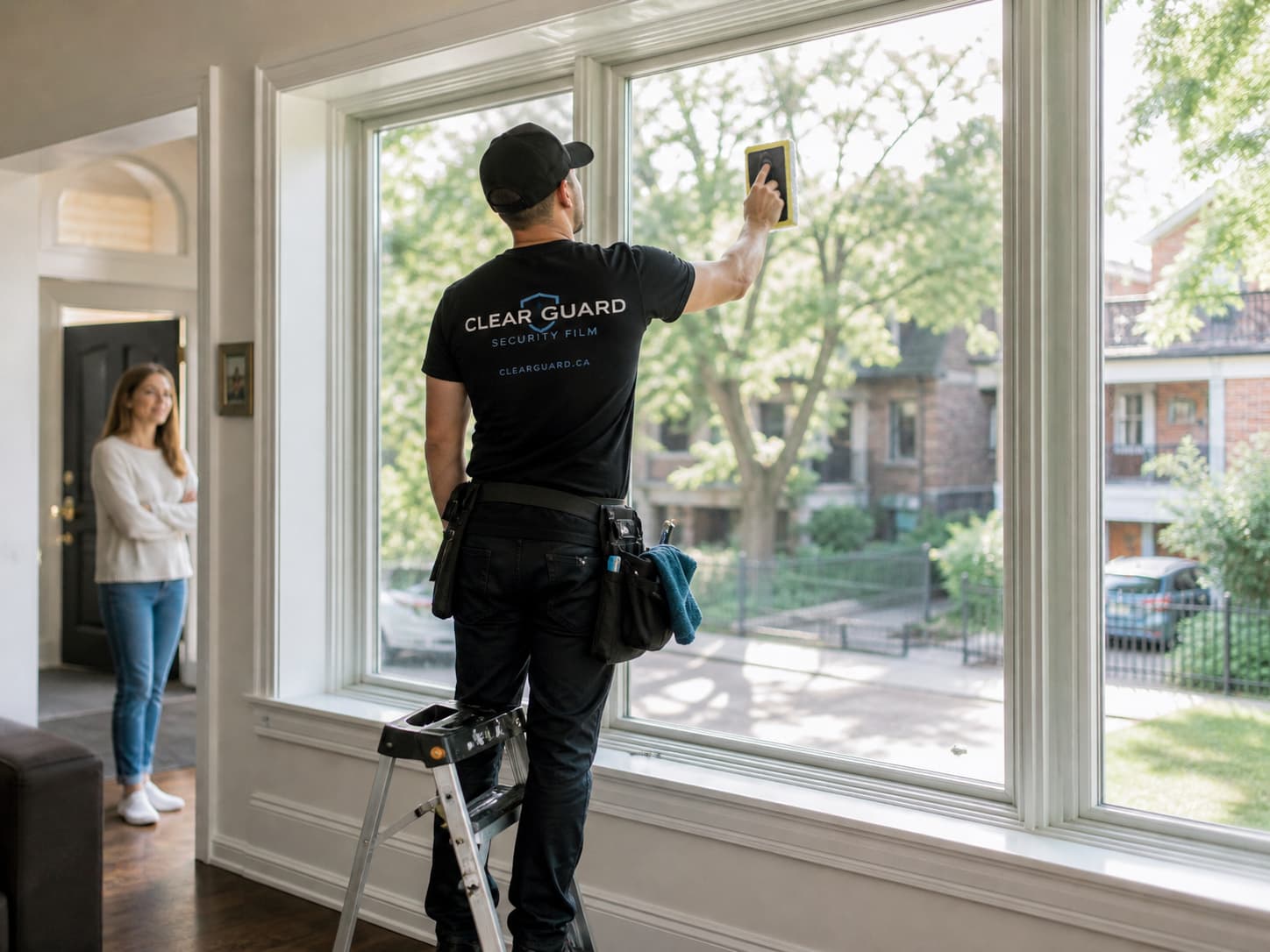
Most residential security film is installed from inside. Each pane is cleaned, the film is fitted, and the application solution is pushed out with a squeegee. Clear film is designed to preserve the view through the window.
Freshly installed film can look hazy or show small water pockets while it cures. The technician provides care instructions for the selected film and conditions; avoid relying on a universal cure-time promise.
On the warranty: the film carries manufacturer-backed coverage, and you can read the full terms on our warranty page. That is the extent of what belongs on a guide like this — the page itself has the detail.
For the full set of expectations during and after the cure, read What to Expect After Security Film Installation.
Security film across the GTA — Toronto, Mississauga, Oakville and beyond
The right film plan depends on the home, not the postal code — but housing stock varies by city, and that changes priorities. Older Toronto and Mississauga subdivisions, Oakville's larger lakeshore glass, and newer builder-grade homes each present different exposed glass. The most exposed glass tends to vary with the housing era and the lot layout.
In Toronto, heritage and character homes often have original sidelight glass beside the front door and single-pane basement windows — glass that is reachable and rarely reinforced. The film case here is partly about preserving the look of the house while adding delay. See the Toronto service area page for local context.
In Mississauga, older subdivisions — back-splits and raised bungalows — carry ground-floor glass exposure that newer homes often design out. The priority is frequently the grade-level and ground-floor panes. See the Mississauga service area page.
In Oakville, larger lakeshore and estate homes tend to have expansive rear glass and walkouts that face away from the street, which shifts attention to the rear of the property. See the Oakville service area page. Across all three, the principle is the same: a plan matched to the actual glass, not a city-wide template.
How to get a film plan for your home
You do not have to figure out the right windows on your own. A Clear Guard technician walks the property, identifies the glass that is most exposed, and explains which windows would benefit from film and which would not. You get a written quote, and the assessment is free and on-site.
Start with the product overview on the security window film page, then book a free on-site assessment.
Frequently asked questions
Does security window film stop break-ins? No. Security film is designed to hold fractured glass together and add resistance while someone tries to clear the pane. It can buy time, but performance depends on the glass, frame, film, and installation.
Is security window film visible once it is installed? Clear security film is designed to preserve the view through the glass. Fresh film may look hazy or show small water pockets during curing; follow the technician’s care instructions before cleaning it.
How do I know which windows in my home need security film? Start with the most exposed glass, which is usually the least obvious: single-pane basement and grade-level windows, large unobstructed ground-floor panes, and glass screened from the street. A Clear Guard technician walks the property during a free on-site assessment and gives a written quote for the windows that matter most.
Related reading
- XPEL vs 3M Security Window Film: 14 Mil Compared
- How Security Window Film Works: A Visual Guide
- Does Security Window Film Actually Stop Break-Ins?
- Security Window Film Guide: Interior, Exterior, and Privacy Options
- Security Window Film vs. Window Bars
- Security Window Film
- Window Film vs. Window Replacement: Cost and Security
- What to Expect After Security Film Installation
- The Glass Breaker Test
- Basement Windows and Grade-Level Glass