Security film is often reduced to a question about thickness: 8 mil or 14 mil? That comparison misses how Clear Guard specifies a residential system.
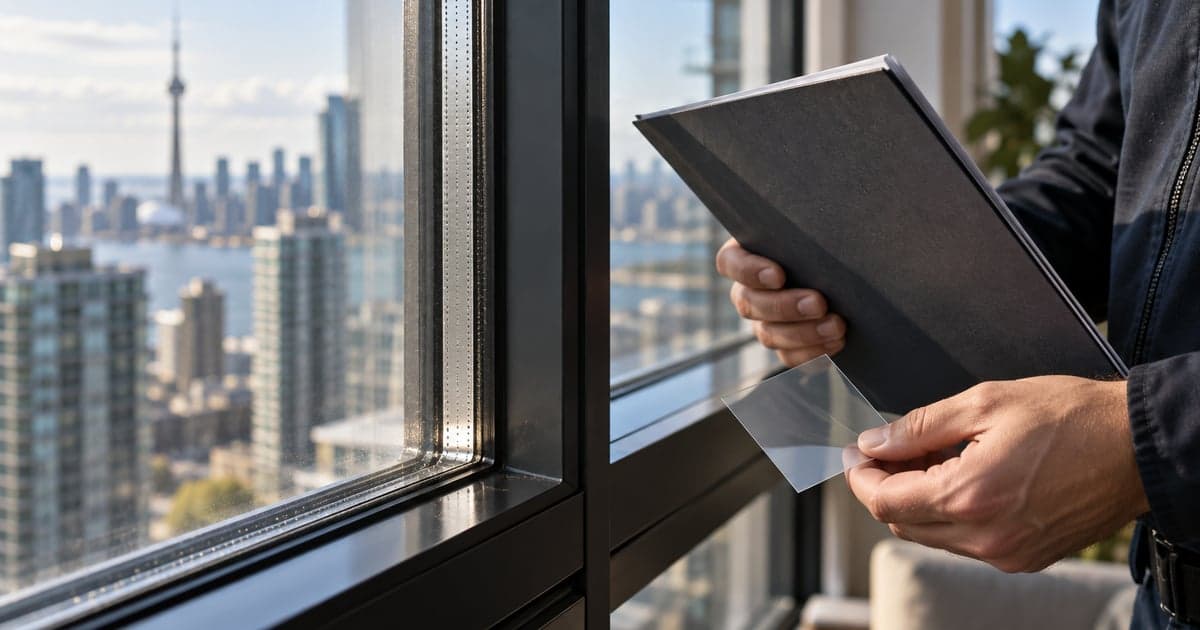
Our primary approach combines 14 mil interior security film with 7 mil exterior security film on the same pane. Most clients receive both layers after we assess the glass and frame.
Where privacy also matters, 12 mil frosted matte interior security film can replace the clear interior layer. An 8 mil interior film remains available for selected applications, but it is not our standard specification.
The Clear Guard residential security-film system
A security-film installation is a combination of film, adhesive, glass, frame, edge attachment, and placement. Thickness is important, but it cannot be judged in isolation.
The interior and exterior products also do different jobs. They are not interchangeable sheets chosen only by which number is larger.
| Position | Primary Clear Guard specification | Purpose |
|---|---|---|
| Interior face | 14 mil clear security film | Helps retain fractured glass and increases the work required to clear the opening |
| Exterior face | 7 mil exterior-rated security film | Adds a weather-rated second layer on the attack side of the pane |
| Privacy locations | 12 mil frosted matte interior security film | Combines security-film construction with a privacy finish |
| Selected applications | 8 mil interior security film | Used when the glass, frame, exposure, or project scope supports it |
The final recommendation is made pane by pane. A patio slider, narrow sidelight, basement window, and inaccessible upper-floor window do not present the same geometry or exposure.
Why 14 mil is our primary interior film
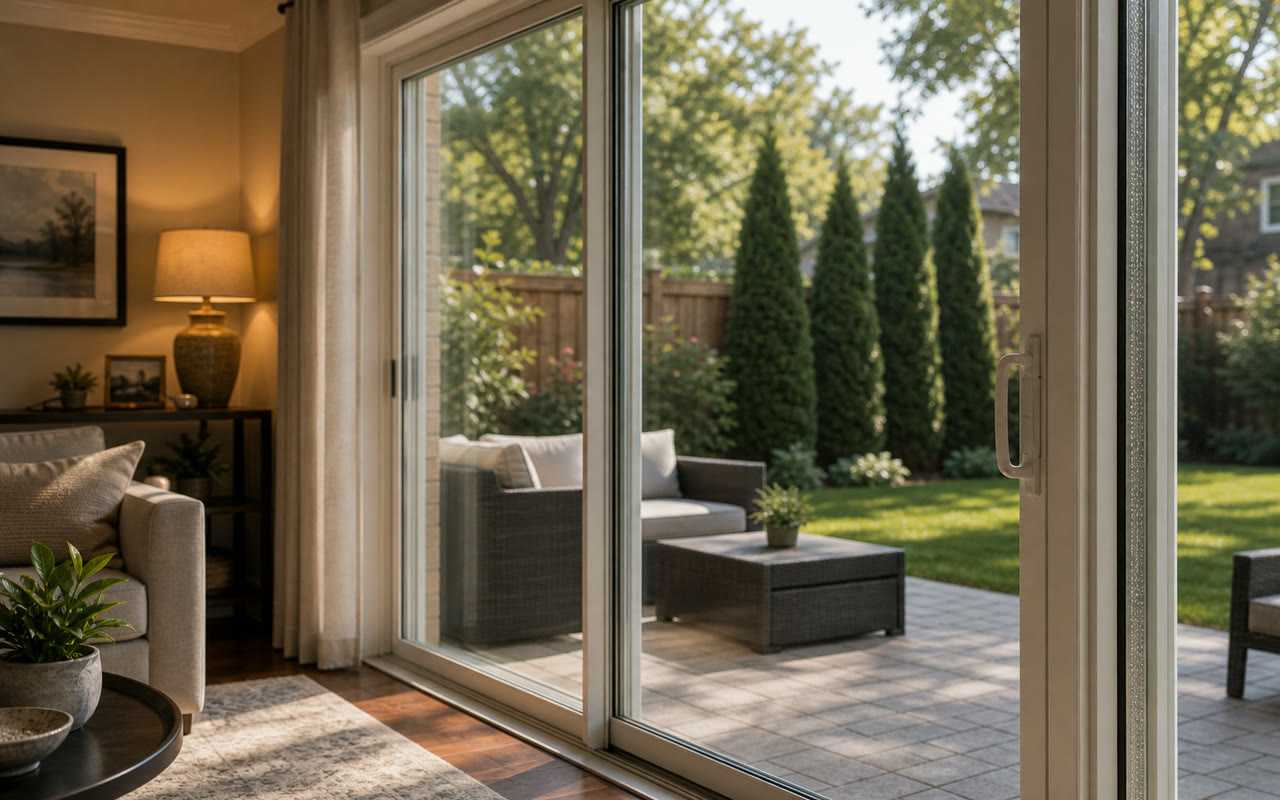
The inside face is protected from direct weather exposure, which makes it the natural location for the heavier interior security layer.
Clear Guard leads with 14 mil interior film because it provides a robust foundation across the accessible residential glass we commonly assess. That includes door glass, sidelights, basement glass, ground-floor windows, and patio doors.
The film does not make a window unbreakable. When glass fractures, the film is intended to hold the broken pieces together and make a fast reach-through or cleared opening more difficult.
How well the completed system performs also depends on the glass, the frame, the attachment method, and the quality of the installation.
Why 7 mil exterior film is a separate product
Exterior security film is manufactured for exposure to sunlight, moisture, temperature changes, cleaning, and weather. It is not interior film moved to the other side of the pane.
Clear Guard's primary system adds 7 mil exterior-rated film to the outside face. Together, the 14 mil interior and 7 mil exterior layers help retain fractured glass from both sides.
Most clients receive this dual-sided system, subject to the assessment. Some frame types, glass configurations, access limitations, or site conditions may require a different recommendation.
Proper edge finishing is especially important outside. The product and installation method must suit exterior exposure rather than relying on thickness alone.
Where 12 mil frosted matte security film fits
Privacy film is sometimes treated as purely decorative. Clear Guard's 12 mil frosted matte product is an interior security film with a privacy finish.
It is useful where a clear view is not desirable, such as sidelights, entry-door glass, lower bathroom windows, or other accessible panes that expose the interior of the home.
In those locations, the 12 mil frosted matte film can replace the clear 14 mil interior layer. A 7 mil exterior layer may still be paired with it when the glass and frame assessment supports a dual-sided system.
The frosted finish changes visibility through the glass. It should be selected deliberately based on the amount of privacy, daylight, and appearance the homeowner wants.
When 8 mil interior film may be used
Clear Guard still uses 8 mil interior security film selectively. It is a legitimate product option, but it is not the default or the centre of our residential offering.
A technician may consider it when the pane, frame, exposure, project scope, or another site-specific factor makes it appropriate. That decision should follow an assessment rather than a blanket rule about window size or price.
This is why a simple “8 mil versus 14 mil” sales comparison is incomplete. It ignores the exterior layer, the privacy-security option, and the completed attachment system.
Glass, frames, and anchoring determine the final specification
Film is bonded to glass, but the glass sits inside a frame. The completed assembly needs to be considered as a system.
During an assessment, we look at:
- glass type and condition;
- frame material and condition;
- exposed glass area and access route;
- locks and nearby reach-through targets;
- interior and exterior installation access;
- privacy requirements; and
- the attachment and edge-finishing method available at that opening.
Film that retains fractured glass but separates too easily at the perimeter cannot provide the same result as a properly attached installation.
Depending on the frame and product specification, attachment may involve extending the film into an accessible frame channel or bonding the film edge to the frame with a compatible structural system.
A practical pane-by-pane guide
The following is a starting point, not a substitute for an on-site assessment.
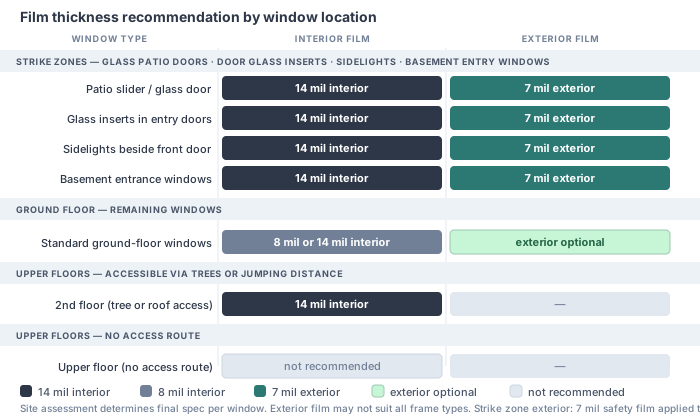
| Glass location or requirement | Starting specification | Assessment note |
|---|---|---|
| Accessible clear residential glass | 14 mil interior + 7 mil exterior | Primary Clear Guard system; confirm glass and frame compatibility |
| Patio sliders and glass doors | 14 mil interior + 7 mil exterior | Review pane size, frame, lock, and installation access |
| Sidelights and door glass | 14 mil interior + 7 mil exterior | Check the distance to the lock and reinforce the door system too |
| Privacy plus security | 12 mil frosted matte interior + 7 mil exterior where suitable | Confirm desired privacy level and exterior compatibility |
| Selected lower-exposure or project-specific panes | 8 mil interior where recommended | Use only after the technician explains why it suits that opening |
| Inaccessible upper-floor glass | Often no film | Prioritize reachable entry points unless an access route exists |
What to ask during a security-film assessment
A useful proposal should explain the system at each opening, not give you a single unexplained thickness for the whole property.
Ask:
- Which panes are accessible enough to justify treatment?
- Will the recommendation use both interior and exterior film?
- Why is 14 mil, 12 mil frosted matte, or 8 mil being specified here?
- Is the exterior product rated for exterior exposure?
- How will the film be attached or finished at the frame edge?
- Which windows are not worth treating?
Clear answers make it easier to compare proposals and avoid paying for low-priority glass while leaving an obvious entry point untreated.
Frequently asked questions
What is Clear Guard's standard residential security-film specification?
Our primary specification is 14 mil clear security film on the interior face and 7 mil exterior-rated security film on the exterior face of the same pane. Most clients receive both after a glass and frame assessment.
Is 12 mil frosted matte film a security film?
Yes. It is an interior security film with a frosted matte privacy finish. It is used when the opening needs both glass retention and reduced visibility through the pane.
Does Clear Guard still install 8 mil security film?
Yes, for selected applications. It is not our standard or primary recommendation. The technician should explain why it suits the specific glass, frame, exposure, and project scope.
Can every window receive 14 mil interior and 7 mil exterior film?
Not automatically. Glass type, frame condition, access, product compatibility, edge finishing, and the value of treating that location all affect the final specification.
Does security film make glass unbreakable?
No. Security film is intended to retain fractured glass and add forced-entry delay. It should be combined with suitable locks, doors, frames, lighting, and other layers of home security.
Related reading:
- XPEL vs 3M Security Window Film: 14 Mil Compared
- Security Window Film for GTA Homes: The Complete Guide
- How Security Window Film Works: A Visual Guide
- Does Security Window Film Actually Stop Break-Ins?
- Patio Door Security: The Most Common Entry Point for GTA Break-Ins
- Basement Windows and Grade-Level Glass