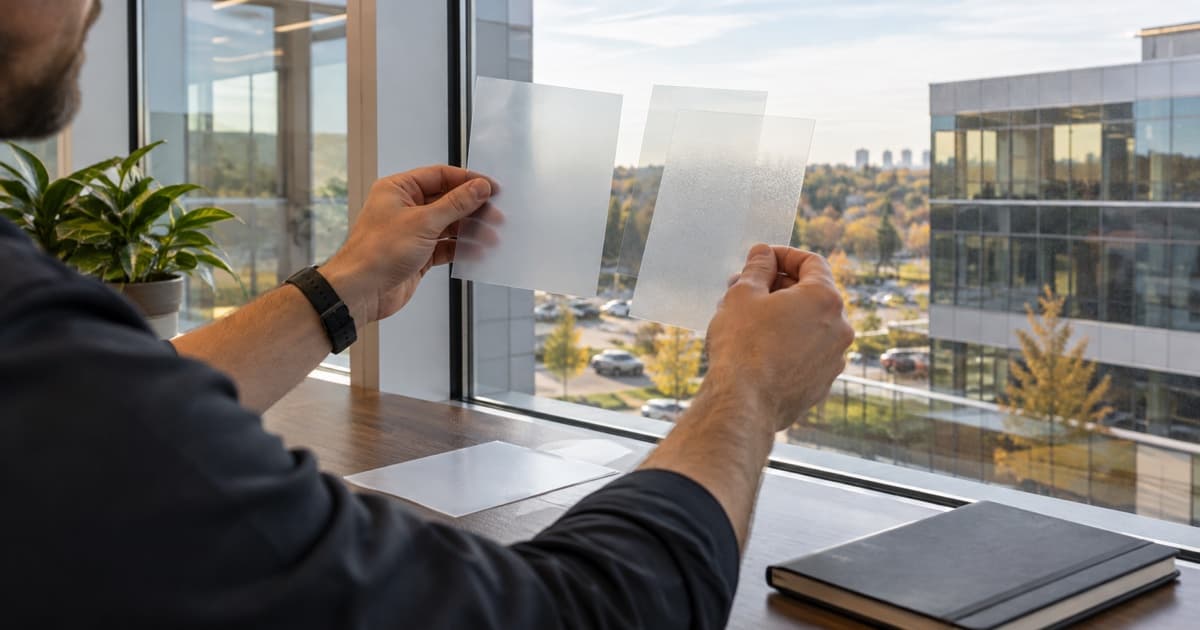
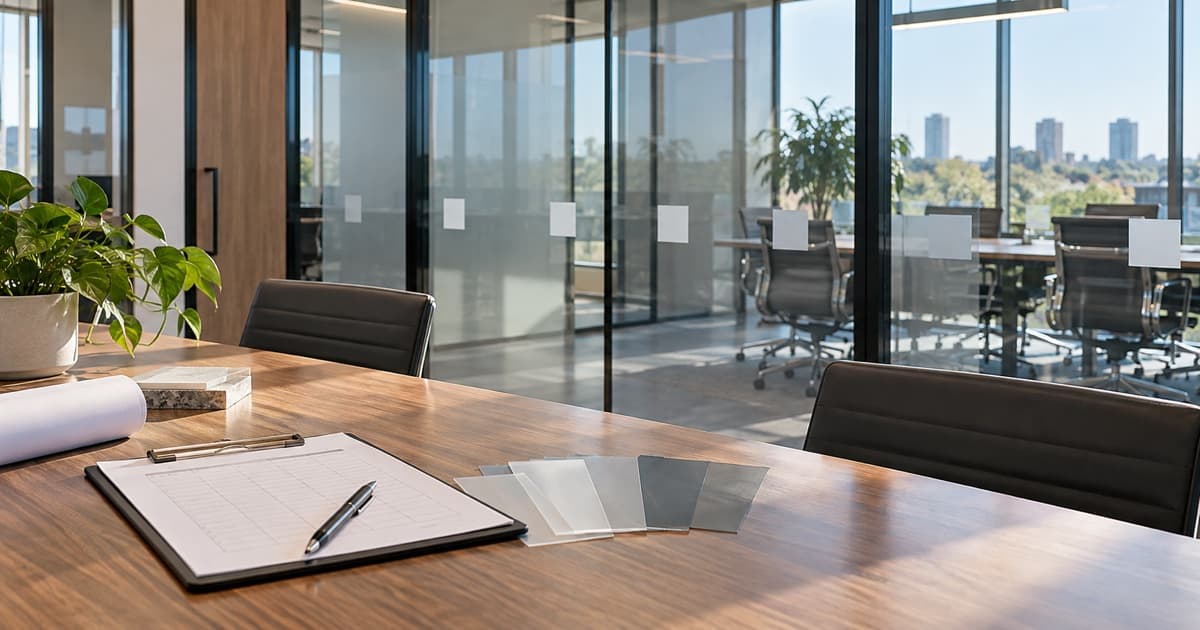
An office privacy film coverage schedule connects each piece of glass to the proposed finish, coverage and approval status. It helps an office manager, property contact and installer discuss the same scope without relying on a marked-up photograph alone.
Use the worksheet below after identifying the views you want screened. For help choosing a finish or comparing partial and full-pane coverage, start with the meeting-room privacy film guide. This worksheet records those decisions and the checks still needed before installation.
Give every pane a stable reference
Start with a room name and a short identifier for each pane or glazed door. Use the same identifiers in the room sketch, photographs, sample notes and quote discussion. A reference such as “Meeting room A — pane A1” is easier to trace than “the window beside the chair,” particularly if furniture moves.
State the viewing direction on your sketch. A simple note such as “viewed from the corridor” prevents left and right from changing when another person looks from inside the room. Mark the entrance so reviewers can orient themselves.
Photograph the overall partition before taking detail photographs. Where permission allows, include a visible pane reference in the photograph or its filename. Keep private screen content and personal documents out of the image.
If a pane has been replaced or has a different glazing construction, record that as information to verify. Similar appearance does not establish identical glass or film compatibility. The identifier should stay stable while its details are checked.
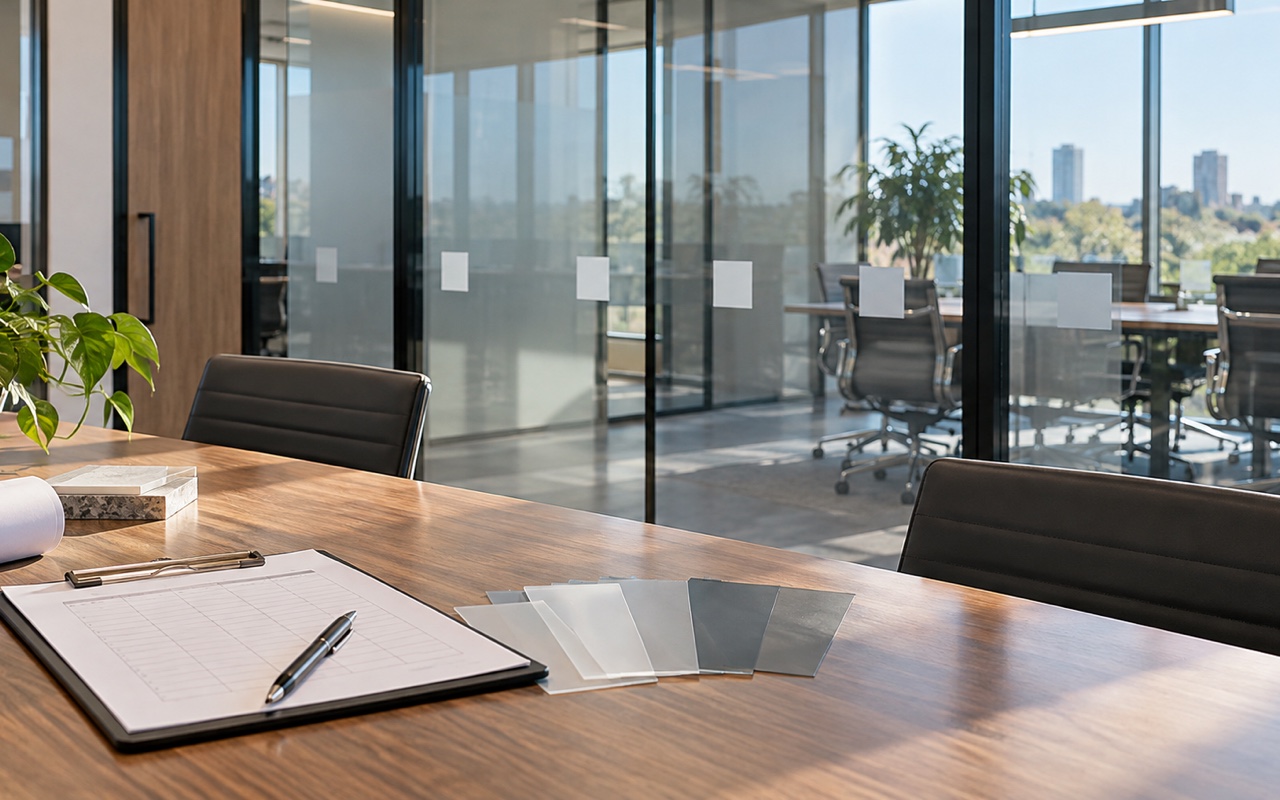
Illustrative editorial image; not a Clear Guard customer property or performance test.
Complete the office privacy film coverage worksheet
A coverage schedule does not need technical drawing software to support an initial discussion. A shared table is useful if it records both the proposal and what remains unresolved.
The two populated rows below are fictional examples. They are not Clear Guard project records, installation dimensions or an approved design.
| Pane reference | Proposed finish and coverage | Retained clear areas | Sample decision | Verification or approval still needed |
|---|---|---|---|---|
| Meeting room A — A1 | Decorative finish to be selected; proposed horizontal band | Glass above and below the proposed band | Review required from the corridor | Agree coverage boundaries; verify dimensions and glazing |
| Meeting room A — A2 | Decorative finish to be selected; proposed full-pane coverage | Any agreed margins to be recorded | Review required with room lights on | Owner to decide whether the retained view is acceptable |
| Your room and pane | Proposed finish and extent | Areas intended to remain clear | Accepted, revise or awaiting review | Named decision or check still outstanding |
Keep the product or finish name separate from the coverage extent. A finish selection does not say where it will be applied. Likewise, “full pane” should not leave the treatment of edges or retained clear areas ambiguous in the final scope.
If you record proposed dimensions, label them as proposed and identify the reference from which they were taken. Do not treat preliminary office measurements as instructions for cutting film. Agree who will verify the final dimensions for installation.
The privacy film product page explains current finishes and selection considerations. XPEL also maintains product specifications and glazing resources; a completed office worksheet does not replace the product-specific review.
Share your pane references, proposed coverage and unresolved decisions when you request an office privacy-film quote. We review the scope by phone before arranging a site assessment.
Record the sample decision in the right row
Describe what was reviewed, where the reviewer stood and which lighting conditions were used. “Sample accepted” is incomplete if it could refer to colour, coverage, privacy or all three.
For example, a reviewer might accept the finish's appearance while leaving the proposed coverage under review. Record those as separate decisions. If privacy is required after dark, include that condition in the review rather than assuming a daytime sample answered it. The evening privacy guide explains the lighting limitations to check.
A sample is an aid to selection, not a formal privacy certification. Keep the recorded decision specific to the observed conditions. Film addresses visual screening; acoustic requirements and other confidentiality measures need separate assessment.
Follow one fictional revision through the schedule
Suppose the office team reviews the two fictional panes above. It asks for A1's proposed band boundaries to be reconsidered but accepts the appearance of the A2 sample. A2's retained view still needs an owner decision.
The useful revision changes the affected rows and their outstanding checks. It does not turn the whole schedule into an approved installation instruction simply because one sample was accepted.
| Revision | What changed | Affected pane | Reviewer | Open action |
|---|---|---|---|---|
| Initial discussion | Band and full-pane options recorded for review | A1 and A2 | Office representative | Sample review and glazing information required |
| Sample review | A1 boundaries remain under review; A2 finish appearance accepted | A1 and A2 | Office and property representatives | Revise A1 proposal; resolve A2 retained view; verify installation details |
| Your next revision | Record the specific change | Relevant pane reference | Person reviewing the change | Decision or verification still required |
This example deliberately omits dimensions. Its purpose is to show how a decision travels through the record, not how to design a particular office partition.
Keep the current version easy to identify. Archive a superseded copy and mark it accordingly, rather than leaving two files both labelled “final.” If someone adds a new pane or changes a finish, check whether the quote and agreed scope also need updating.
Connect approval with the installation scope
Before the scope is confirmed, identify the people responsible for appearance, property permissions and installation verification. One person may handle several roles, but the decisions should still be recorded separately.
Use the commercial film quote checklist to connect the pane schedule with access, timing and quote requirements. The schedule is one part of the project record, alongside the selected product, verified scope and agreed working arrangements.
For a larger office, begin with a room inventory through commercial film services. Keep references consistent as the discussion moves from rooms to individual panes. That makes a revision easier to trace without presenting preliminary notes as approval.
Frequently asked questions
What should an office privacy film coverage schedule include?
Include the room and pane reference, proposed finish, coverage boundaries, retained clear areas, sample decision and outstanding checks. Add the reviewer and revision reference. Separate design preferences from glazing compatibility and installation verification so an accepted appearance is not mistaken for approval of every part of the job.
Who confirms measurements before privacy film is installed?
Agree who will verify installation dimensions and document the final scope. Preliminary measurements supplied by the office can help with discussion, but label them as proposed. A worksheet with measurements is not, by itself, an instruction to cut or install film. Keep unresolved dimensions visible until the responsible person confirms them.
What happens if the privacy film layout changes after a sample review?
Update the affected pane rows, the revision record and any open decisions. Reconcile the change with the quote and proposed work before proceeding. A change to coverage may also require another sample or sightline review. Do not assume the original price, work period or approval automatically covers the revised scope.
Prepare your office privacy-film scope
Planning privacy film for a Southern Ontario office? Send the location, approximate pane count and your proposed coverage schedule. Request an office privacy-film quote. Clear Guard reviews the project before arranging an assessment and written quote.