

GTA Home Security Statistics 2026: What the Data Actually Shows
If you want to understand break-and-enter risk in your neighbourhood, you don't need to speculate. Toronto Police Service, Peel Regional Police, and York Regional Police all publish open data on reported incidents. The numbers tell a different story than most fear-based marketing does — and that data can help you make smarter decisions about which entry points to harden first.
This guide walks you through what the data shows, where to find it, and how to use it for your own home assessment.
About the data sources
Three police services publish break-and-enter data covering the GTA: Toronto Police Service (TPS) for Toronto proper, Peel Regional Police (PRP) for Mississauga, Brampton, and Caledon, and York Regional Police (YRP) for Markham, Vaughan, Richmond Hill, Whitchurch-Stouffville, and surrounding areas.
Each service publishes data differently:
- Toronto Police Service maintains the most accessible data through its public data portal at data.torontopolice.on.ca, with neighbourhood-level breakdowns and a web map interface that lets you search by postal code or district.
- Peel Regional Police publishes incident counts and maintains a Crime Occurrence Mapping Application showing patterns across Mississauga and Brampton for the past 36 months.
- York Regional Police offers a Community Safety Data Portal with quarterly incident breakdowns across the service area.
What the data includes
All three services track:
- Incident type: break and enter vs. attempted break and enter
- Location: neighbourhood, district, or postal code
- Date and time: allowing seasonal and time-of-day analysis
- Some services include entry method: forced door, forced window, or other forced entry
Important limitations
The data reflects reported incidents only. Some break-ins go unreported, especially in commercial or multi-unit residential settings where theft may not be discovered immediately. Data is also published with a lag — typically 2–8 weeks behind the incident date. Finally, the data shows whether an incident was reported, not whether an arrest was made or charges were laid.
Despite these limitations, this is the most reliable publicly available data on residential security in the GTA.
Toronto Police Service break-and-enter data
Toronto reported 6,092 break-and-enter incidents in 2025, representing an 11% decrease from 2024. This is down from over 6,800 in 2023, reflecting a longer-term decline in reported break-and-enters across the city.
The citywide break-in rate in 2025 worked out to 189.5 incidents per 100,000 residents.
Neighbourhood breakdown
Break-and-enter incidents are not evenly distributed across Toronto. Some neighbourhoods report significantly higher rates than others.
University neighbourhood had the highest break-in rate in the city in 2025, with 730 incidents per 100,000 residents — nearly four times the city average. With 60 reported incidents in a relatively small population, University stands apart from all other Toronto neighbourhoods.
Other high-incident neighbourhoods (by absolute count, not rate) include districts in Scarborough, North York, and Etobicoke where higher population density and mixed residential-commercial zoning create more opportunity for incident clustering. However, raw incident counts can be misleading: a neighbourhood with 100 incidents and 100,000 residents (1 per 1,000) has lower actual risk than a neighbourhood with 50 incidents and 10,000 residents (5 per 1,000).
The TPS data portal lets you search any neighbourhood or postal code to see reported incidents for the past three years, so you can assess your specific area without speculation.
Time-of-day patterns
More than 80% of reported break-ins occur during daylight hours, typically between 10 AM and 3 PM — when most households are at work or school. This reflects a fundamental shift in break-in strategy: burglars are less interested in confrontation and more interested in target homes they know are unoccupied.
Nighttime incidents do occur, particularly between 11 PM and 4 AM, but they represent a smaller portion of reported break-ins and often indicate more targeted or opportunistic attempts when offenders know a home is vacant.
Seasonal patterns
The TPS data shows variation across months, but the 2025 figures do not yet reveal a consistent seasonal spike pattern that would indicate winter or summer is significantly higher-risk. What data does suggest is that homes are more at risk during family vacation periods — both winter holidays and summer breaks — when occupancy patterns shift predictably.
Peel Regional Police statistics
Peel Regional Police (serving Mississauga, Brampton, and Caledon) reported 2,301 break-and-enter incidents from January to December 2025 across both municipalities — 1,216 in Mississauga and 1,080 in Brampton. This represents a 12% decrease from 2024's total of 2,622 incidents.
The decline mirrors Toronto's downward trend, though Peel's absolute numbers are lower due to a smaller combined population.
City-level breakdown
Mississauga reported 1,216 incidents in 2025, making it the higher-count municipality in the Peel service area. Brampton reported 1,080 incidents. The difference reflects both population size and residential density, but per-capita rates would require dividing by the exact population of each city to determine true comparative risk.
Trend analysis
Year-over-year, Peel saw a 12% decline in break-and-enter incidents from 2024 to 2025. October 2025 showed a temporary spike with 258 incidents — the highest monthly total for that year — suggesting seasonal or operational factors may have driven a short-term increase.
York Regional Police data
York Regional Police (serving Markham, Vaughan, Richmond Hill, Whitchurch-Stouffville, and surrounding areas) reported 1,057 residential and commercial break-and-enter incidents as of mid-2025, representing an 11% decline from 1,189 incidents the same period in 2024.
In early 2026 (Q1: January–March), YRP reported even more significant decreases:
- Residential break-and-enters down 22%: from 374 incidents in early 2025 to 290 in Q1 2026
- Commercial break-and-enters down 42%: from 240 to 139 incidents
These declines suggest that enforcement efforts and public awareness campaigns are having measurable effects across the GTA.

What the numbers actually mean for homeowners
Raw statistics can amplify anxiety without providing actionable insight. Here's how to interpret the data in practical terms.
Risk context by neighbourhood
A neighbourhood with 100 reported incidents does not mean every home is equally at risk. University neighbourhood's high rate reflects its demographics: student rental housing, transient population, and mixed-use streets where valuables are more visible and occupancy patterns are irregular. A quiet suburban neighbourhood with 50 reported incidents and twice the population actually has lower per-capita risk.
The key insight: your specific home's vulnerability — visible valuables, weak doors and windows, occupancy patterns, lighting, sightlines from the street — matters as much as neighbourhood statistics.
Daytime preparedness
Since 80% of break-ins occur during daylight hours, your weekday security posture matters more than nighttime. This means:
- Ensure ground-floor windows and doors are reinforced even when you're home but not watching them.
- Close interior blinds during work hours to reduce visibility of valuables.
- If you work from home or have a flexible schedule, vary your occupancy patterns so they're not predictable.
- Motion-sensor lighting outside entry points is a deterrent even in daylight, signaling an occupied home.
Entry method awareness
While the TPS portal does not currently publish a complete city-wide breakdown of entry method (door vs. window), the data confirms that break-and-enters succeed because offenders target the weakest point. In older Toronto homes with original wooden frames and single-pane windows, glass is often the fastest entry. In newer construction with standard hardware, the door frame under kick force is the vulnerability.
A professional assessment on your property will reveal which entry points are most exposed in your specific home.
Prevention prioritization
Use the data to inform your security layering:
Check the incident data for your neighbourhood or postal code. If reported incidents are clustered near ground-floor windows, prioritise window film on those exposures. If incidents suggest forced-door entry patterns, start with door fortification.
Assess your home's visibility and occupancy. A home visible from the street with regular occupancy patterns creates different risk than one set back behind trees with variable hours. Adjust priorities accordingly.
Layer defences. Data shows that offenders move on quickly when a target resists. Combining window film, reinforced door hardware, and motion lighting creates delay — the most effective deterrent.
How to use this data for your own assessment
Step 1: Find your neighbourhood data
- Toronto residents: Visit data.torontopolice.on.ca, search your neighbourhood or postal code, and see reported incidents for the past three years.
- Mississauga or Brampton residents: Visit Peel Regional Police's Crime Occurrence Mapping Application and search your postal code.
- York Region residents: Visit the YRP Community Safety Data Portal and view incidents by area.
Step 2: Note the patterns
Look for:
- Absolute incident count for your area
- Whether incidents cluster near your address
- Whether reported incidents suggest forced-door or window-entry patterns (if this detail is available)
- Seasonal variation if data spans multiple years
Step 3: Cross-reference with your home
Walk the perimeter of your home and note:
- Which windows are visible from the street or neighbouring properties
- Which doors face public access (front, side, garage entry)
- Whether motion lighting or camera coverage exists
- The age and condition of door frames, locks, and window frames
Step 4: Prioritize based on data and assessment
If your neighbourhood data shows window-entry incidents are more common, film is likely your first investment. If door-kick incidents dominate, door fortification is the priority. If your area shows lower absolute incidents, focus on your home's specific vulnerabilities rather than neighbourhood averages.
Step 5: Schedule a professional assessment
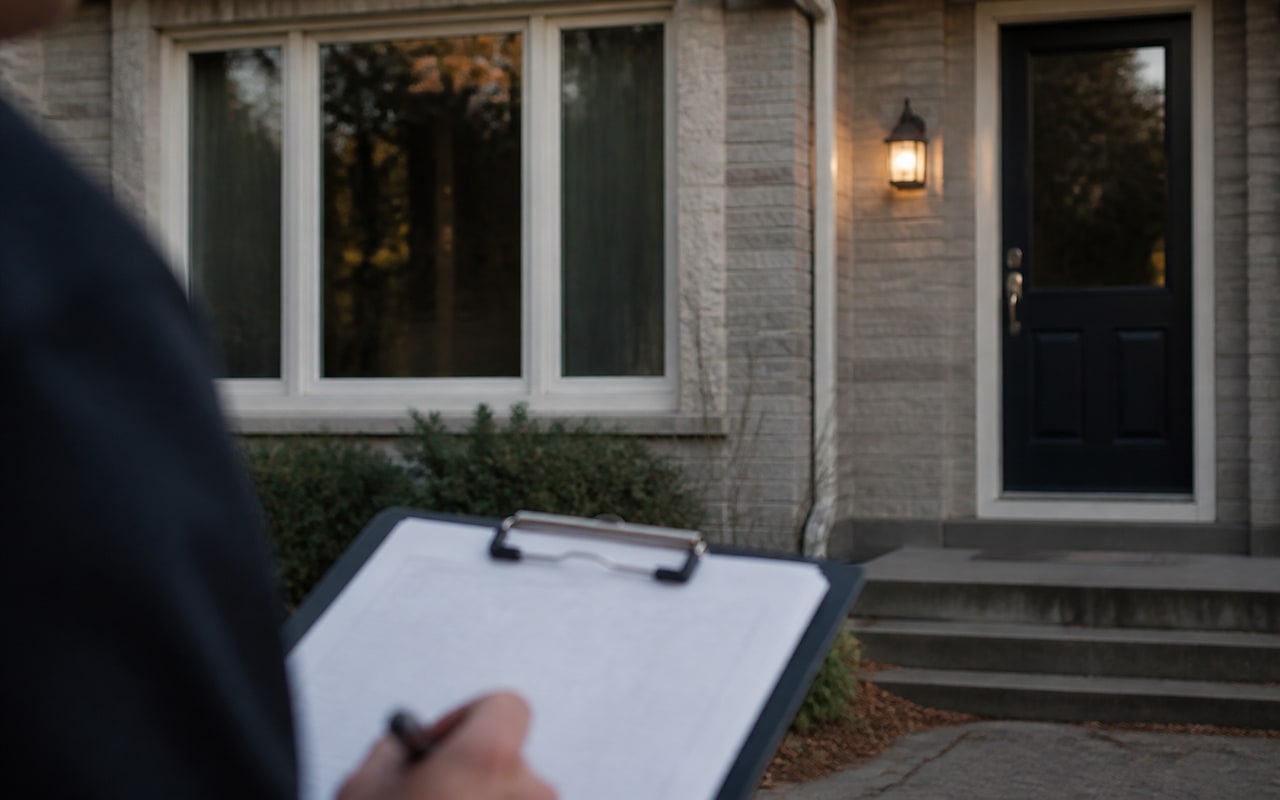
Your neighbourhood's statistics are one data point. Your home's specific vulnerabilities are another. A Clear Guard technician will assess your actual entry points and recommend hardening based on what you have, not just what the statistics say. Assessments are free and take about 30 minutes.
Frequently asked questions
What does the break-and-enter data show about the GTA?
The data shows that reported break-and-enter incidents are declining across Toronto, Peel, and York Region in 2025–2026, with year-over-year drops ranging from 11% to 42% depending on the area and category (residential vs. commercial). Most break-ins occur during daylight hours when homes are unoccupied, and incident rates vary dramatically by neighbourhood. University neighbourhood in Toronto, for example, has a rate nearly four times the city average.
Is my neighbourhood at high risk for break-ins?
Neighbourhood statistics provide context, but your home's specific vulnerabilities matter as much or more. A home with a weak door frame, visible ground-floor valuables, and poor lighting is at higher risk than a well-lit, hardened home in a higher-incident neighbourhood. The data should inform your priorities, not drive anxiety.
Which entry points do most break-and-enters use?
This depends on your area and property type. If data for your neighbourhood is available through the police portals, it may show whether forced-entry attempts target doors or windows. A professional assessment on your property confirms your specific exposures, which is more actionable than neighbourhood averages.
Ready to understand your home's actual risk profile? Book a free on-site assessment. A technician evaluates your entry points and provides a recommendation tailored to your property, not just neighbourhood averages. No obligation.