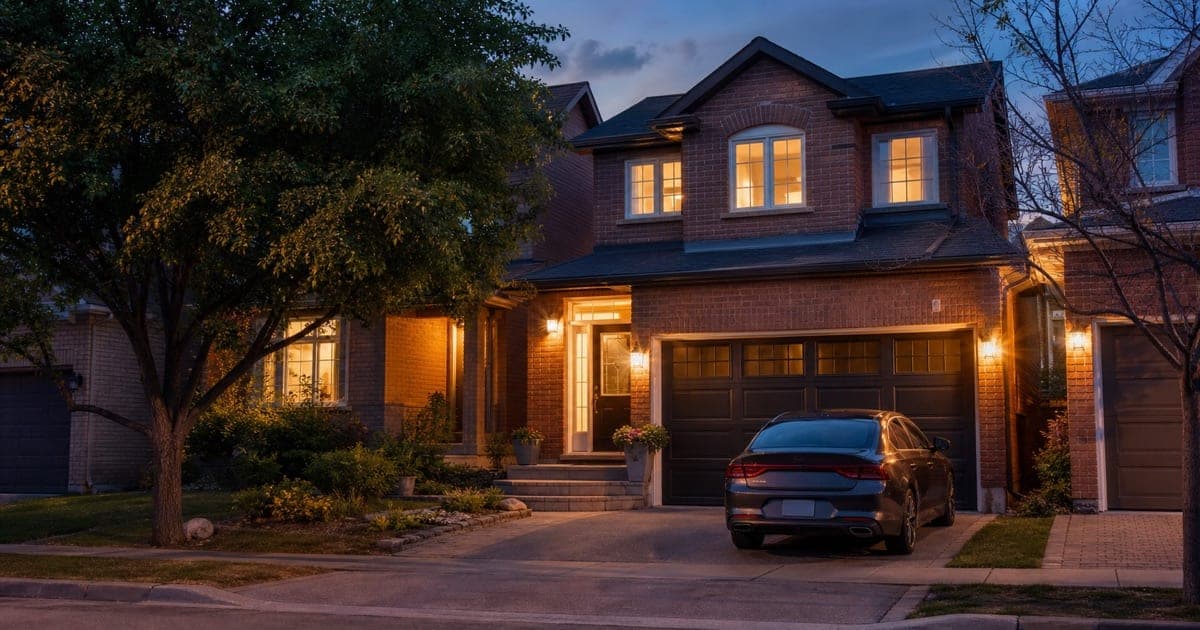
Most GTA homes built after 1980 have an attached garage. It's convenient — you park out of the weather, you're steps from the kitchen. But the attached garage creates a security chain that most homeowners don't think about: the overhead door, the garage interior, and the door that connects the garage to the house.
If someone gains access to the garage, they arrive at that interior door — and in many GTA homes, that door is the least-hardened entry point in the house.
This post explains how that access chain works, where the gaps are, and what takes 30 minutes (and sometimes no money) to address.
The Attached Garage as an Entry Vector
An attached garage sits between the driveway and the interior of the house. Most homes have two doors in this chain:
- The overhead door — typically automatic, operated by a remote fob or wall-mounted keypad
- The interior door (mandoor) — connects the garage to the house interior
If someone breaches the overhead door — by any means — they arrive inside the garage, facing only the mandoor.
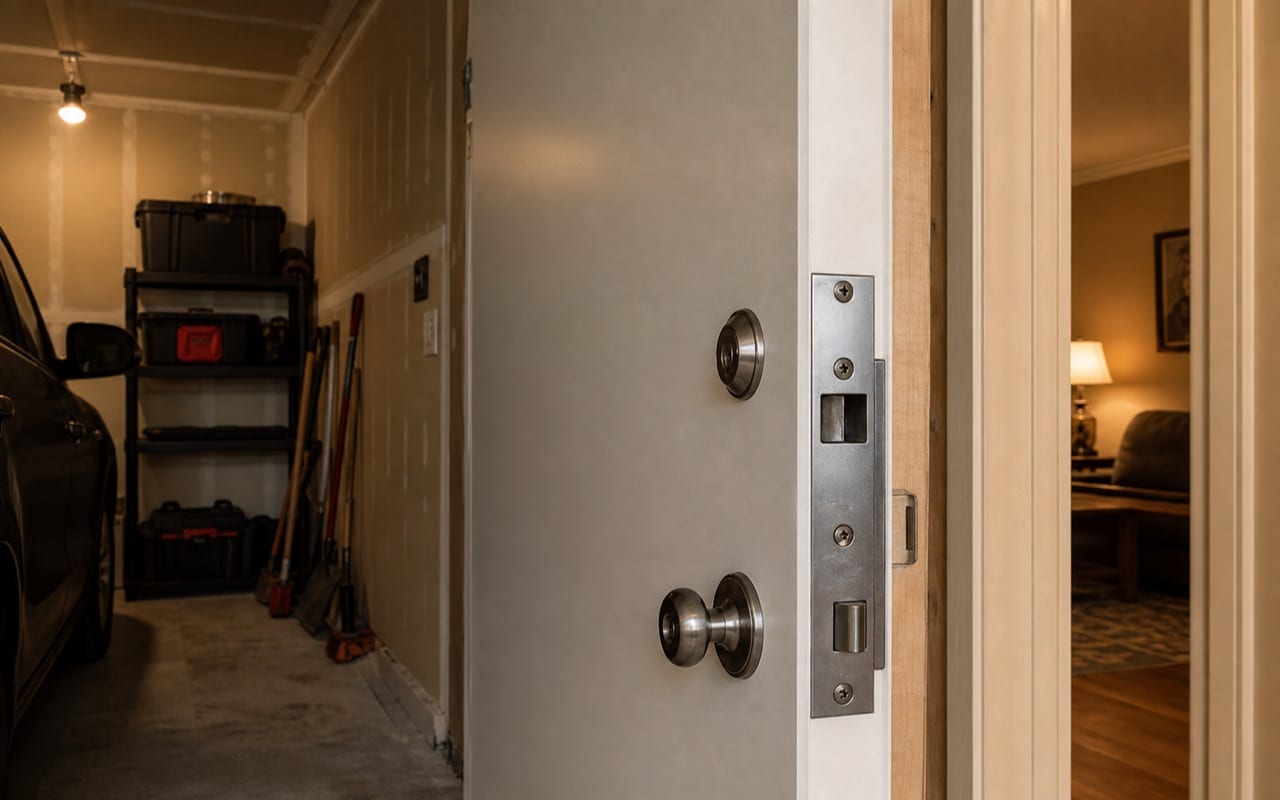
In many GTA subdivision homes built between 1985 and 2005, the mandoor is hollow-core: the same construction used for interior bedroom doors. It's fitted with a standard doorknob, a single-point latch, and a strike plate designed for a light door in an interior partition wall. It is not rated as an exterior door, even though it is functionally one — it controls access to the interior of the house from a space accessible from outside.
The frame is typically the same dimensional lumber used for interior walls, not the reinforced framing used on the front door. The result: a hollow-core door and a standard strike plate offer very little resistance to a forced-entry attempt.
This is the structural argument for treating the mandoor as an exterior door in every way.
How Keyless Entry Relay Amplification Works
Modern keyless entry fobs emit a low-power radio signal. The car listens for that signal within a short range. When the fob is in range, the car unlocks and, on most systems, enables push-button start.
Relay amplification devices can capture and amplify that signal across a greater distance — allowing the car to "believe" the fob is nearby when it is not.
Here's the process:
- A thief near the vehicle pulls the door handle, triggering the vehicle to broadcast a search signal for the key fob
- A relay device near your home receives that signal and amplifies it
- The amplified signal broadcasts into your house, looking for a response from your key fob
- If the fob receives the amplified signal, it responds
- That response is relayed back to the car, and the door unlocks
The vulnerability is this: the key fob regularly broadcasts a low-power signal because the car is always quietly asking whether a valid key is nearby. Thieves exploit that constant radio chatter. They pick up the fob's signal leaking through the wall and amplify it to a level the car can detect.
This is a function of how the radio protocol works, not a GTA-specific phenomenon. Storing a fob near an exterior wall or door reduces the distance the signal must travel to be captured.
Where Vehicle Fobs Should NOT Be Stored
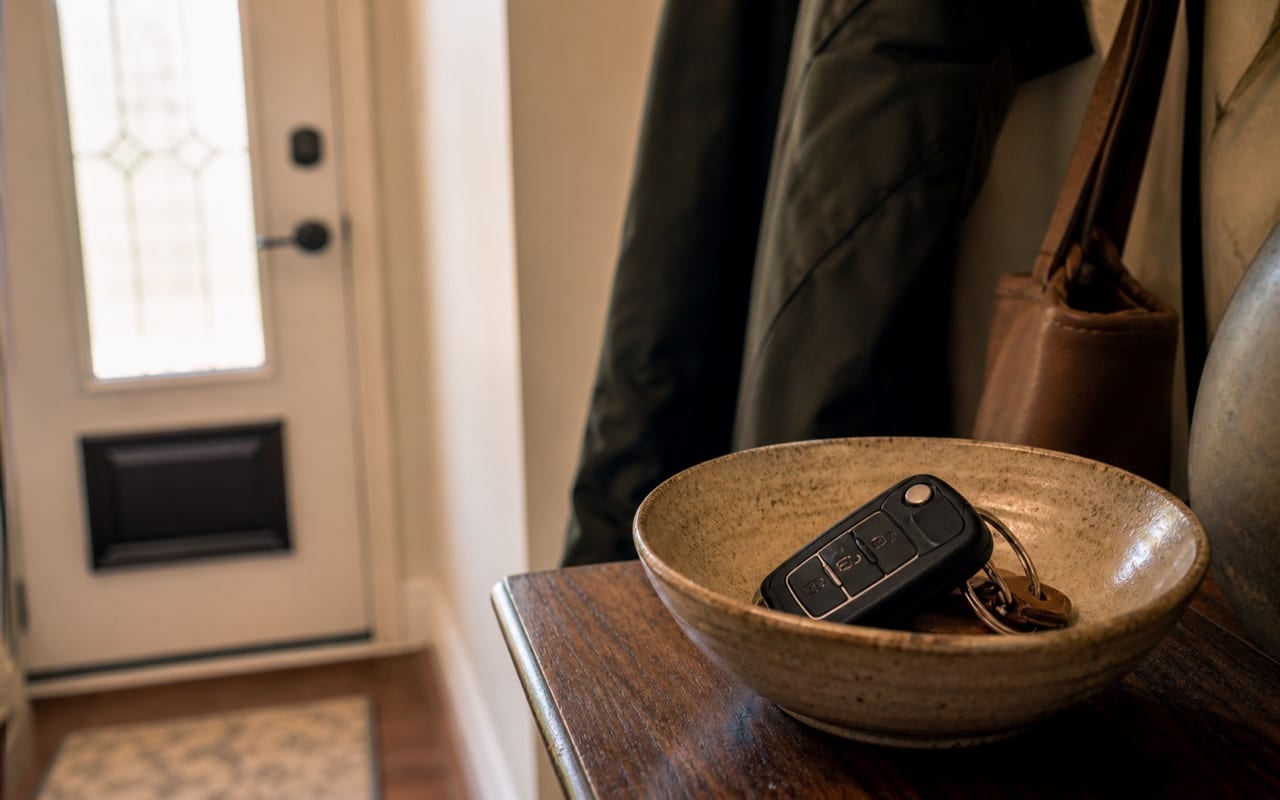
The most common location for vehicle keys in GTA homes is near the front door — in a key bowl, on a hook, in a jacket pocket hung on a rack near the entrance. This is exactly where they are most vulnerable to relay amplification.
High-risk storage locations:
- Near the front door (key bowl, hook on wall, jacket hung on a door rack)
- On a counter near a sidelight window flanking the front door
- In a car in the driveway, even if locked (a remote clipped to the visor can open the overhead door)
- On a hook visible from a garage window
- In a bag or coat hung near any exterior wall
The security principle: Keep the fob behind enough material — interior walls, not just a door — that a signal cannot be easily amplified from outside.
Practical No-Cost Steps
Move vehicle fobs away from the front door and exterior walls. Any interior room works: a bedroom, a kitchen drawer, a bedside table. The goal is to create distance and material barriers between the fob and the exterior.
Purchase a Faraday pouch. These signal-blocking pouches (available for $10–$20 online) line the key with conductive material that blocks the radio signal when the fob is inside. When the fob is in the pouch, it cannot transmit or receive a signal. This is a practical first step for keys not in active use overnight. Faraday pouches are effective when well-made and properly maintained, though they can wear over time with daily folding and use.
Remove the overhead remote from your vehicle. If your vehicle has an integrated garage door remote clipped to the visor, remove it from the car when parked. This prevents a relay-amplified car fob from unlocking the garage at the same time it unlocks the vehicle.
Inspect and reinforce the mandoor. The mandoor's strike plate screws can usually be replaced with longer structural screws (7.5 cm / 3") that anchor into the framing stud rather than the door stop. This 20-minute fix, done with a standard screwdriver, meaningfully improves resistance. Check the hinges: if they are on the garage side with exposed hinge pins, the door can sometimes be lifted from the hinge side. Add a secondary lock (deadbolt) if one is not present.
These steps improve the situation but do not address the structural weakness of a hollow-core mandoor and a standard residential frame.
The Interior Garage Door — The Critical Second Door
Once inside the garage, an intruder faces only the mandoor. In GTA subdivision construction — particularly homes built between 1985 and 2005 — this door is often a structural weakness.
What to check:
- Knock on the door. Does it sound hollow? (Hollow-core doors sound like drums; solid doors sound dull.)
- Pull the door shut and look at the strike plate. Is it a standard 2.5 cm plate held by short screws into the door stop?
- Look at the frame. Is it solid wood or hollow/thin?
If you have a hollow-core mandoor with a standard strike plate and light framing, you are looking at a door that offers minimal resistance to a forced-entry attempt. It is installed to interior-door specifications in a functionally exterior location.
Where ARX Guard Fits — The Mandoor Case
ARX Guard door fortification is designed for exactly this profile: a door that is treated by the builder as interior but is functionally exterior.
Here's what it does:
- Upper component attaches to the structural frame above the door (the header)
- Lower component attaches to the threshold (the piece directly below the door)
- A hockey-stick mechanism with a latch ties the door into the entire door frame
- Combines a heavy-gauge strike plate with structural screws that anchor into the framing stud (not the door stop)
- Reinforces hinges against forced-entry attempts from the hinge side
On a mandoor, this converts a lightly anchored interior-spec door into one that distributes forced-entry force across the full frame and stud system. The door resists forced entry at the lock area — where you kick next to the handle — which is the weak point on standard residential doors. Available in multiple colors to match your existing hardware or door.
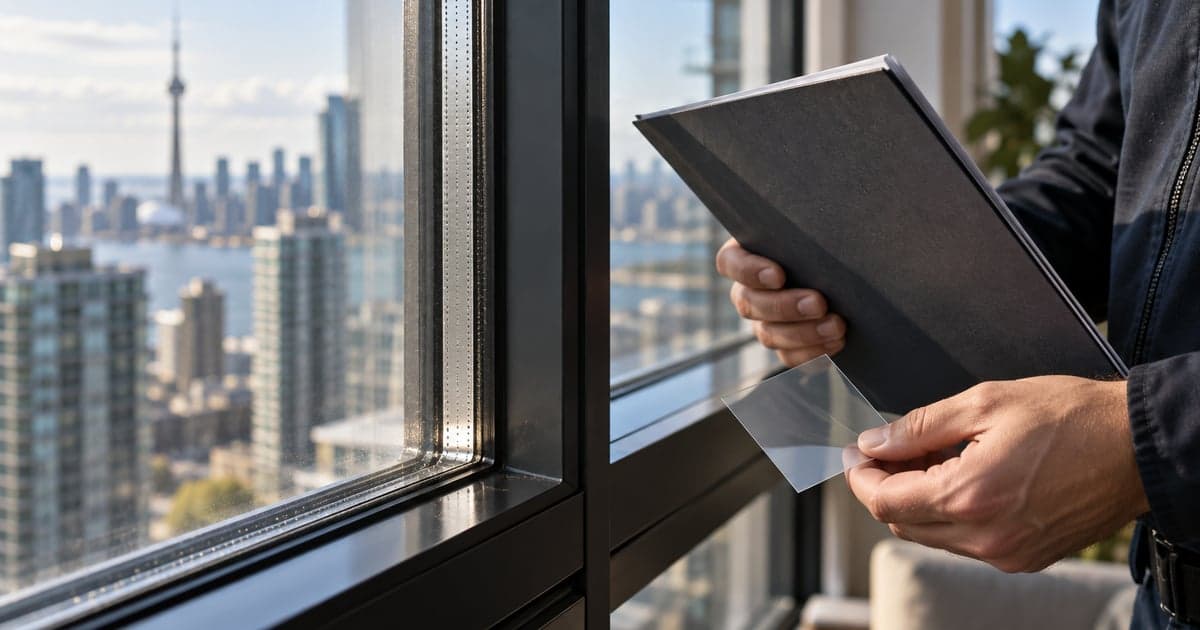
For garage windows — if your garage has sidelights or glass panels — security window film holds fractured glass together and makes the pane harder to clear.
Clear Guard’s primary system combines 14 mil interior with 7 mil exterior security film. Most clients receive both after assessment. A 12 mil frosted matte interior option adds privacy; 8 mil interior is used selectively.
These are delay and resistance measures, not guarantees. They are designed to slow entry long enough that an intruder looks for an easier target or you have time to respond.
Free Assessment — What a Clear Guard Technician Checks
If you want a second opinion on your mandoor and garage setup, a Clear Guard technician can walk the space with you. The assessment is free, takes about 30 minutes, and comes with a written summary.
A technician will check:
- Mandoor type and frame construction
- Strike plate depth and screw length
- Hinge side and pin exposure
- Overhead door remote location (in vehicle vs. wall-mounted keypad only)
- Garage window glazing (original single-pane vs. updated)
- The overall exposure and where reinforcement makes sense
Book a free garage and mandoor assessment. A technician will tell you exactly what the exposure looks like — and what would close it. No installation commitment required. Written quote within 48 hours if work is recommended.
FAQ
Can someone use my car key fob to open my garage door?
Only if the vehicle has an integrated overhead remote clipped to the visor (which is becoming less common). A keyless entry fob alone opens the car, not the garage. However, if a relay device amplifies both the car fob signal AND the garage remote signal simultaneously, both devices could be unlocked at the same time. The safest practice: remove the overhead remote from the vehicle when parked.
What type of door should the garage-to-house door be?
Functionally, it should be treated as an exterior door — solid core (or reinforced hollow core), reinforced frame, deadbolt, and heavy-gauge strike plate. Standard interior-spec doors leave the house vulnerable from a garage that is accessible from the driveway.
Is a Faraday pouch actually effective?
Yes, a well-made Faraday pouch blocks the radio signal when the fob is inside it, preventing relay amplification. It is a practical first step and costs little. However, Faraday pouches can wear over time with daily folding and use, so quality matters.
Ready for a professional assessment? Book a free garage and mandoor evaluation.